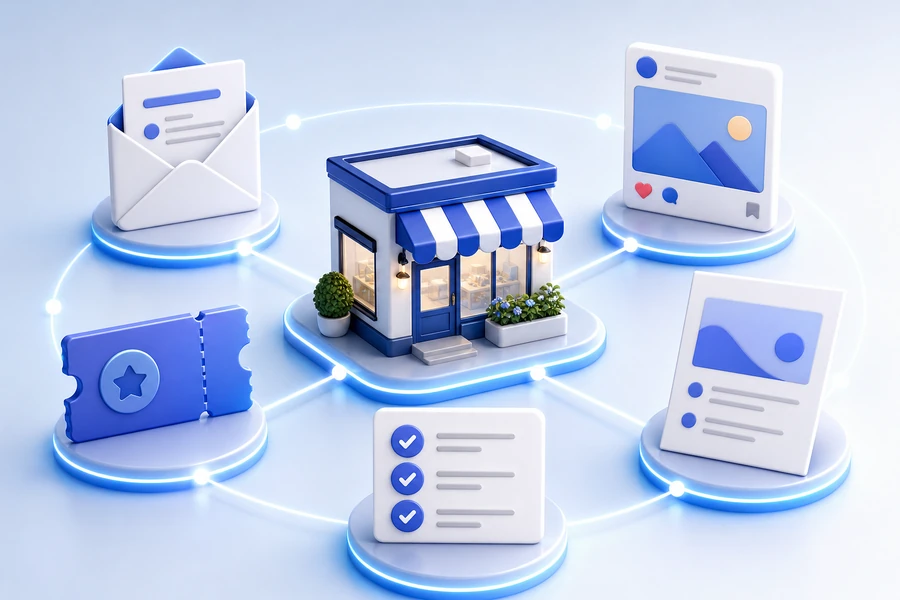
A local promotion becomes more effective when customers encounter one clear message in several appropriate places. That does not mean copying the same graphic everywhere. A multi-channel campaign starts with one offer and adapts the explanation, format, and next step for each audience touchpoint.
Define the offer precisely
Write down who the promotion is for, what they receive, why it matters now, the dates, exclusions, and the action required. If the team cannot explain it in one short paragraph, customers will struggle too. Confirm operational capacity before publishing the offer.
Create one campaign message
Choose a simple promise connected to the customer’s need. Support it with two or three proof points, such as convenience, included value, or relevant experience. Use the same core promise across channels so the campaign feels connected even when individual assets look different.
Build the website destination
Create or update a page that contains the complete details. Include the offer, eligibility, timing, frequently asked questions, and one primary call to action. Every digital channel should point to this reliable source instead of trying to fit all conditions into a caption.
Adapt the message by channel
Use a Google Business Profile update for discovery and immediate action. Use social posts to show the benefit visually, answer questions, and provide reminders. Send an email to customers who are likely to care, with a clear subject and direct link. Use in-store signage or a flyer when the promotion is relevant to visitors already nearby.
Plan the sequence
Launch with the full announcement, follow with education or proof, add a midpoint reminder, and close with an accurate final notice. Avoid artificial urgency. If availability changes, update every active channel and the destination page quickly.
Equip the team
Give staff a short campaign summary, answers to likely questions, and the correct booking or redemption process. Marketing breaks down when the public message and customer experience do not match. A small internal checklist can prevent missed details.
Measure the full path
Track inquiries, bookings, redemptions, landing-page visits, and channel-specific links when practical. Also record customer questions and operational issues. The campaign review should consider both results and delivery quality.
Save what can be reused
After the campaign, archive the approved message, design components, frequently asked questions, links, and performance notes. The next promotion can begin with a proven structure instead of a blank page. Reuse the system while updating the offer and evidence for the new objective.
One well-defined promotion can supply weeks of coordinated content. By building the message once and adapting it thoughtfully, a local business creates more visibility without inventing separate campaigns for every platform.

Join the discussion